
Dentures

Table of Contents
What Are Dentures?
Types of Dentures
Full Dentures
Partial Dentures
Implant-Supported Dentures
- More stability
- Improved comfort
- Better jawbone health
- Easier to chew with
- Simple to clean and maintain
What Is the Process for Getting Dentures?
Step 1: The Consultation
Step 1.5: Getting Your Implants
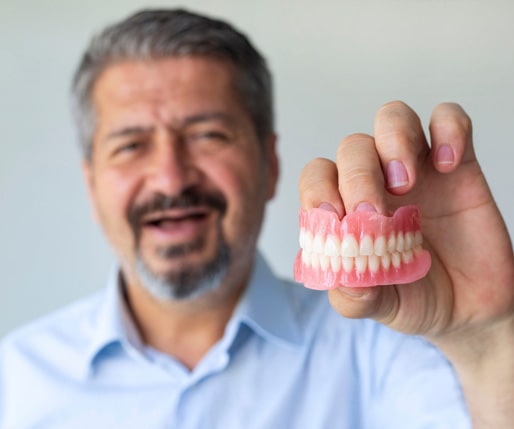
Step 2: Taking Impressions
Step 3: Receiving Your Dentures


Do I Need Dentures?
- Dental Implants: Implants can support individual crowns as well. Patients with only one or a couple of missing teeth tend to see the greatest benefit from implants.
- Dental Bridges: Bridges are a budget-friendly option for replacing gaps in your smile. Patients missing one or two teeth in a row may be suitable for bridges.
How Long Do Dentures Last?
Frequently Asked Questions
How much do dentures cost?
The price of your dentures will depend on their type, the materials they are made of, and the number of teeth replaced. Traditional dentures typically cost between $2,000 and $5,000 per arch, while partial traditional dentures cost up to $3,500. Implant-retained (snap-in) and fixed implant-supported dentures can be significantly more expensive as complex surgical procedures are required to place the implants. Such options can cost between $7,000 and $30,000, depending on the number of teeth replaced and the number of implants used to support the dentures.
Am I a good candidate for dentures?
Dentures can be an excellent solution for people who are missing multiple teeth in a row or entire arches of teeth. Apart from that, ideal candidates are typically required to have sufficient gum and jawbone health for dentures to be properly supported. If you opt for implant-supported dentures, the requirements are stricter as your body will need to handle a complex implant placement surgery.
Are dentures better than dental implants or bridges?
Generally, dental implants, implant-supported dentures, and bridges provide more stability and chewing power than traditional dentures. However, for people who cannot have those types of dental restorations, dentures will still provide significant improvements in the appearance of your smile, chewing function, and speaking.
How long does it take to get dentures?
Getting traditional removable dentures may take between 3 and 12 weeks. If you need your natural teeth extracted first, the entire process will take closer to 12 weeks. If the process involves only an exam, taking impressions, and denture manufacturing, it is likely to take around 3 to 4 weeks.
Getting implant-supported dentures will take significantly longer, as the implants will need to fuse with your jawbone before the dentures can be attached to them. This process typically takes 4 to 8 months.
Will dentures look natural?
Modern dentures look natural in the mouth when they are fitted properly and made of high-quality materials. They closely mimic natural tooth enamel and gum tissue and are designed with your facial structure and skin tone in mind.
How do I care for my dentures?
If you have traditional removable dentures, proper care involves the following:
- Clean your dentures daily with mild soap or a specialized denture paste
- Soak dentures in water or a mild denture-soaking solution overnight to prevent them from drying out
- Rinse your dentures after every meal
- Clean your dentures above a bowl with water to prevent breaking them if you accidentally drop them
- Never use hot water to clean your dentures
Is denture treatment covered by insurance or financing available?
Most dental insurance plans partially cover dentures. You may expect around 50% of the final cost to be covered. However, many insurance plans have yearly maximums, meaning that you will have to pay anything above the limit out of pocket. Also, some plans may have waiting periods before covering major restorative work. We recommend contacting your dental office and insurance company before the procedure to ensure that it will be covered by insurance. To learn about our financing offers, do not hesitate to contact our office at (619) 333-5986.
What can I eat with dentures?
Traditional dentures that rely on your jawbone and gums for support offer limited biting and chewing force compared to our natural teeth. Therefore, you will have to avoid foods that are hard to chew, such as:
- Crackers and nuts
- Hard raw vegetables and fruits
- Sticky foods
- Tough meats
It is recommended to opt for soft foods and cut your food into smaller pieces to prevent your dentures from shifting or slipping due to pressure applied by chewing.
If you have implant-supported dentures, you can eat the majority of the foods as they provide up to 95% of natural chewing and biting force. However, it is still recommended to avoid very hard, crunchy, and sticky foods.
Book Your Consultation
Give yourself back the smile you deserve with dentures with the El Cajon dentist. Call Dr. Mansour’s office or use the online form to set up your consultation.
 Request Appointment